🕷️ Tarantulas
Mexican Redleg Tarantula Care Guide
Brachypelma emilia — White, 1856
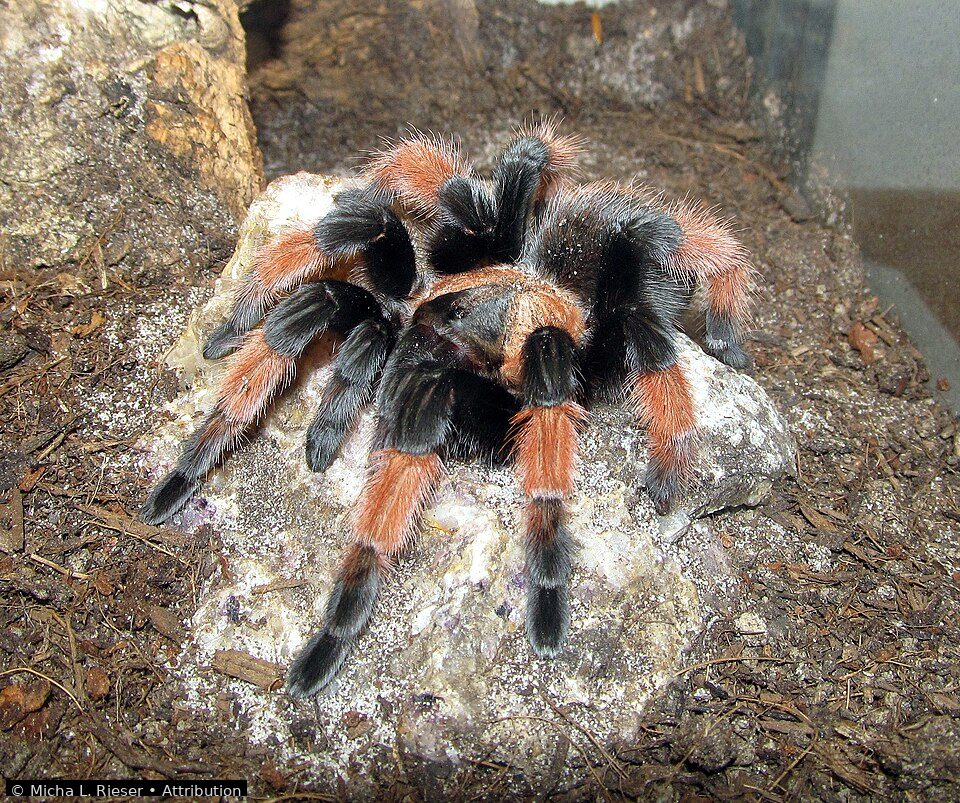
Image: Wikimedia Commons
Experience
Beginner
Lifespan
20–25 years (females)
Adult Legspan
5–6 in DLS
Origin
Pacific Mexico
Brachypelma emilia — White, 1856
Image: Wikimedia Commons
Brachypelma emilia — the Mexican Redleg, sometimes called the Mexican Painted Redleg — is native to the dry Pacific scrublands of north-western Mexico. Like its close relatives, it is a terrestrial burrower adapted to a warm, seasonally arid landscape of rock, scrub, and hard-packed soil.
It shares the genus's protected (CITES) status, so only captive-bred specimens should be kept — and it breeds well in captivity. Its care mirrors the other Mexican Brachypelma: mostly dry, warm, well-ventilated, and undemanding.
The Redleg is unmistakable, with red-orange legs, a salmon-pink carapace, and a distinctive black triangle pointing forward between the eyes. Hardy, long-lived, and generally docile, it is an excellent and underrated beginner display species.
The Mexican Redleg is terrestrial and a moderate burrower. Prioritise floor space and substrate depth, and keep the enclosure low to protect this heavy-bodied spider from falls.
| Life Stage | Enclosure | Notes |
|---|---|---|
| Spiderling (under 1") | Deli cup / small vented container | Mostly dry substrate, deep enough to burrow, small water source |
| Juvenile (1–3") | 16 oz – 1 gal enclosure | Deep substrate, cork hide, shallow water dish |
| Sub-adult / Adult (3"+) | 5–10 gal or equivalent | 3–5 in of substrate, cork hide, water dish, good airflow |
Fill the enclosure one-half to two-thirds with substrate — coconut fibre, peat, or topsoil — to give burrowing depth while keeping the spider close to the floor. Add a cork bark hide and a permanent water dish, and ensure good ventilation.
Warm and mostly dry reflects the Pacific Mexican scrub. No supplemental heating is needed in most homes.
| Parameter | Target | Notes |
|---|---|---|
| Temperature | 75–85°F (24–29°C) | Warm; avoid sustained drops below 65°F |
| Ambient Humidity | 55–65% RH | Mostly dry with a lightly dampened corner |
| Substrate | Mostly dry | Dampen one corner or overflow the water dish occasionally |
| Water | Permanent water dish | Keep filled at all times |
The Mexican Redleg is a steady eater, though it can be on the slow-growing side and may fast for spells, particularly around a moult. This is normal in a healthy, plump spider.
Prey: Gut-loaded crickets, Dubia roaches, and the occasional mealworm. Keep prey no larger than the spider's abdomen.
Frequency: Juveniles every 5–7 days, adults every 7–10 days when feeding. Keep the water dish full during any fast.
Remove uneaten prey within 24 hours, especially during pre-moult when the spider is vulnerable.
Growth is slow to moderate, with mature adults moulting roughly once a year. A fresh moult restores the vivid red-and-pink colouration at its best.
Pre-moult signs: A darkened abdomen, food refusal, lethargy, and sometimes a web mat over the substrate. Remove all live prey at the first signs.
Post-moult: Leave the spider undisturbed and wait 7–14 days before feeding so the new exoskeleton and fangs harden fully. Keep the water dish topped up throughout.
The Mexican Redleg is generally docile, though it can be skittish and will bolt or flick hairs if startled. Its venom is very mild. As with any tarantula, handling is done at the keeper's own risk and is never entirely without it.
Urticating hairs are present (Type III) and may be kicked off the abdomen when the spider feels threatened — they can irritate skin and are especially uncomfortable near the eyes. Keep sessions calm and brief, stay low over a soft surface, and never handle over a hard floor, as a fall can rupture the abdomen and be fatal.
Print-friendly version of this guide — formatted for keepers on the go.
Download PDF