🕷️ Tarantulas
Goliath Birdeater Tarantula Care Guide
Theraphosa blondi — Latreille, 1804
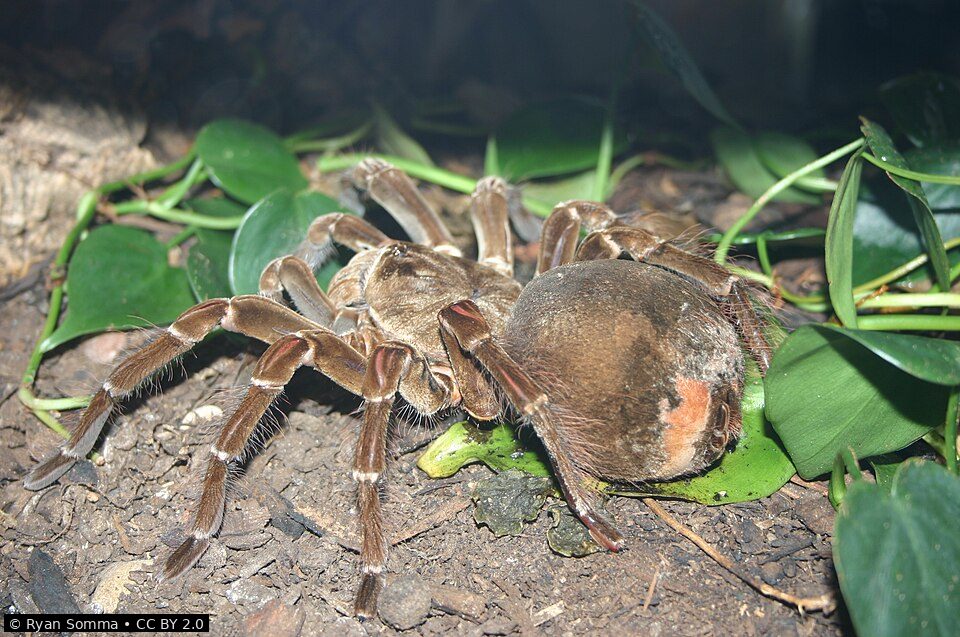
Image: Wikimedia Commons
Experience
Advanced
Lifespan
15–25 years (females)
Adult Legspan
Up to 11–12 in DLS
Origin
Northern South America
Theraphosa blondi — Latreille, 1804
Image: Wikimedia Commons
Theraphosa blondi — the Goliath Birdeater — is the largest tarantula on Earth by mass, native to the deep, humid rainforests of northern South America, including Guyana, Suriname, French Guiana, and northern Brazil. It lives in deep burrows in the moist forest floor, often near swampy or low-lying ground.
Despite the dramatic name, it does not routinely eat birds; it preys mostly on large invertebrates and the occasional small vertebrate. Its true requirement is a stable, very humid burrow environment — replicating that consistently is the core challenge of keeping it, and the reason it is an advanced-keeper species.
An adult can span up to 11–12 inches and weigh well over 100 grams, with a russet-brown body and a dense coat of irritating hairs. It is powerful, defensive, and equipped with large fangs and potent urticating setae — a magnificent display animal for experienced keepers, but never a beginner's spider.
The Goliath is a large fossorial species that needs both floor space and serious substrate depth. The enclosure must be robust, escape-proof, and kept low — a spider this heavy is badly injured by any fall.
| Life Stage | Enclosure | Notes |
|---|---|---|
| Spiderling (under 1.5") | Vented container with deep substrate | Damp substrate, burrow depth, small water source |
| Juvenile (2–4") | 2–5 gal with deep substrate | Moist substrate, cork hide, water dish |
| Sub-adult / Adult (5"+) | 18×18×12 in (or larger), low | 4–8+ in of moist substrate, large cork hide, big water dish |
Provide 4–8+ inches of moisture-retaining substrate — coconut fibre, topsoil, and sphagnum moss — over a large footprint. Add a substantial hide and a large water dish. Maintain ventilation even at high humidity to keep air from going stale.
Warm and consistently humid mirrors the rainforest floor. The key is high humidity in damp substrate with airflow — humid, not stagnant and swampy.
| Parameter | Target | Notes |
|---|---|---|
| Temperature | 75–82°F (24–28°C) | Stable warmth; avoid sustained drops below 70°F |
| Ambient Humidity | 75–90% RH | High — maintained mainly through damp substrate |
| Substrate | Damp, not waterlogged | Keep the lower layers moist; overflow the water dish as needed |
| Water | Large water dish | Always full; a major humidity and drinking source |
The Goliath is a powerful feeder that takes large prey. It has a hearty appetite as it grows but, like all tarantulas, should not be over-fed into obesity.
Prey: Large gut-loaded roaches, crickets, and locusts; adults can take the largest feeder insects. Keep prey no larger than the spider's abdomen. Avoid vertebrate prey — it is unnecessary and messy.
Frequency: Juveniles every 5–7 days, adults every 7–10 days or as appetite dictates. Growing juveniles in particular eat readily.
Remove uneaten prey within 24 hours, especially during pre-moult when the spider is vulnerable.
Moulting is the highest-risk time for this species, and stable humidity is critical to a safe moult. A fresh moult restores the dense, irritating coat of hairs and the russet colouration.
Pre-moult signs: A darkened abdomen, food refusal, lethargy, and often sealing of the burrow. Remove all live prey at the first signs and ensure the substrate stays damp.
Post-moult: Leave the spider completely undisturbed and wait 2–3 weeks before feeding so the new exoskeleton and large fangs harden fully. Keep humidity steady throughout.
Handling is strongly discouraged for the Goliath Birdeater. It is large, heavy, defensive, and equipped with substantial fangs — and a fall would be catastrophic for a spider of this mass. There is no responsible reason to handle one.
Its urticating hairs (Type III) are among the most irritating of any tarantula and are flicked readily, often accompanied by a loud stridulating hiss as a warning. They can cause serious skin and respiratory irritation. Always work with the enclosure rather than the spider, use long tools, and consider eye and respiratory protection when doing close maintenance or rehousing.
Print-friendly version of this guide — formatted for keepers on the go.
Download PDF