🕷️ Tarantulas
Curly Hair Tarantula Care Guide
Tliltocatl albopilosus — Valerio, 1980
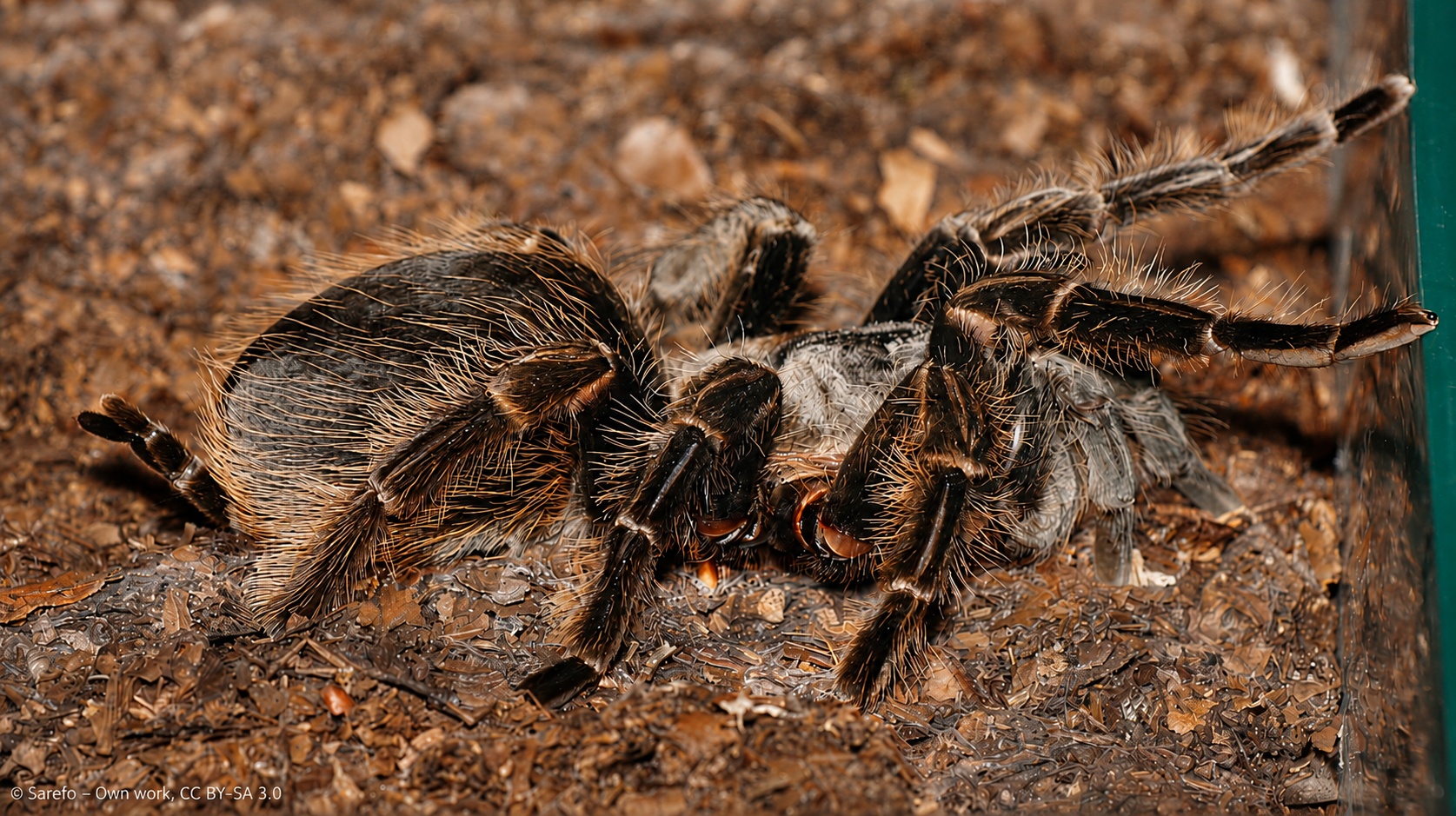
Image: Wikimedia Commons
Experience
Beginner
Lifespan
Up to 20+ years (females)
Adult Legspan
5.5–6.5 in DLS
Origin
Central America
Tliltocatl albopilosus — Valerio, 1980
Image: Wikimedia Commons
Tliltocatl albopilosus — the Curly Hair, formerly classified as Brachypelma albopilosum — is native to the rainforests and forest edges of Central America, ranging across Honduras, Nicaragua, and Costa Rica. It is frequently found near rivers and at the bases of trees, sheltering in burrows, leaf litter, and natural cavities in the forest floor.
Its habitat is humid but not waterlogged — warm tropical forest where the deeper soil stays slightly moist while the surface dries between rains. This shapes its captive care: a semi-burrowing species that appreciates deep substrate and a damp lower layer rather than a constantly wet enclosure.
The common name comes from the long, curled bristles that cover the body and legs, giving the spider a distinctly woolly, unkempt look. Most individuals are a warm brown to bronze, with the curled setae catching a coppery sheen under light. Hardy, slow-moving, and forgiving of beginner mistakes, the Curly Hair is one of the most widely recommended first tarantulas in the hobby.
The Curly Hair is a terrestrial, semi-burrowing species. Prioritise floor space and substrate depth over height — a wide, shallow enclosure with deep bedding suits it far better than a tall one. As a rule of thumb, give an adult a footprint roughly three times its leg span in each direction.
| Life Stage | Enclosure | Notes |
|---|---|---|
| Spiderling (under 1") | Deli cup / small vented container | Damp substrate, deep enough to burrow, small water source |
| Juvenile (1–3") | 16 oz – 1 gal enclosure | Deep substrate, cork bark hide, shallow water dish |
| Sub-adult / Adult (3"+) | 5–10 gal or equivalent | 3–5 in of substrate, cork hide, water dish, good ventilation |
Fill the enclosure with 3–5 inches of substrate — coconut fibre, peat moss, or a topsoil mix — so the spider can dig a starter burrow. Add a piece of cork bark or a half log as a hide and keep décor minimal. Cross-ventilation matters: stagnant, overly damp air encourages mould and mites.
Comfortable room temperature and moderate moisture suit this tropical-forest species. There is no need for supplemental heating in most homes.
| Parameter | Target | Notes |
|---|---|---|
| Temperature | 70–80°F (21–27°C) | Room temperature is fine; avoid sustained drops below 68°F |
| Ambient Humidity | 65–70% RH | Moderate — keep the lower substrate lightly moist, surface drier |
| Substrate | Damp lower layer | Overflow the water dish or dampen one corner periodically |
| Water | Permanent water dish | Keep filled at all times; refresh every few days |
The Curly Hair is a steady, reliable eater with a good appetite. It is an opportunistic ambusher that will take prey from the substrate, and it rarely refuses food outside of pre-moult.
Prey: Gut-loaded crickets, Dubia roaches, and the occasional mealworm. Keep prey no larger than the spider's abdomen.
Frequency: Spiderlings roughly twice a week, juveniles every 7–10 days, and adults every 2–3 weeks. A plump but not stretched abdomen is the target — overfeeding adults simply makes them sluggish.
Remove any uneaten prey within 24 hours, especially during pre-moult, as crickets can stress or injure a vulnerable spider.
Spiderlings moult frequently as they grow, slowing to once or twice a year as adults. Moulting is when the spider replaces its exoskeleton, and a fresh moult restores the curled bristles to their fullest, coppery best.
Pre-moult signs: A darkened abdomen, food refusal, lethargy, and sometimes a thin web mat laid over the substrate. Remove all live prey at the first signs.
Post-moult: Leave the spider undisturbed and wait 7–14 days before feeding so the new exoskeleton and fangs can harden fully. Keep the water dish topped up throughout.
The Curly Hair is among the most docile tarantulas in the hobby and tolerates gentle, occasional handling better than most. Adults are typically calm and slow-moving, though spiderlings can be more skittish. As with any tarantula, handling is done at the keeper's own risk and is never completely without it.
Urticating hairs are present (Types I & III) and may be kicked off the abdomen if the spider feels threatened — these can irritate skin and are especially uncomfortable near the eyes. Keep sessions calm and brief, stay low to a soft surface, and never handle over a hard floor, as a fall can rupture the abdomen and be fatal.
Print-friendly version of this guide — formatted for keepers on the go.
Download PDF