🐍 Snakes
Carpet Python Care Guide
Carpet Python
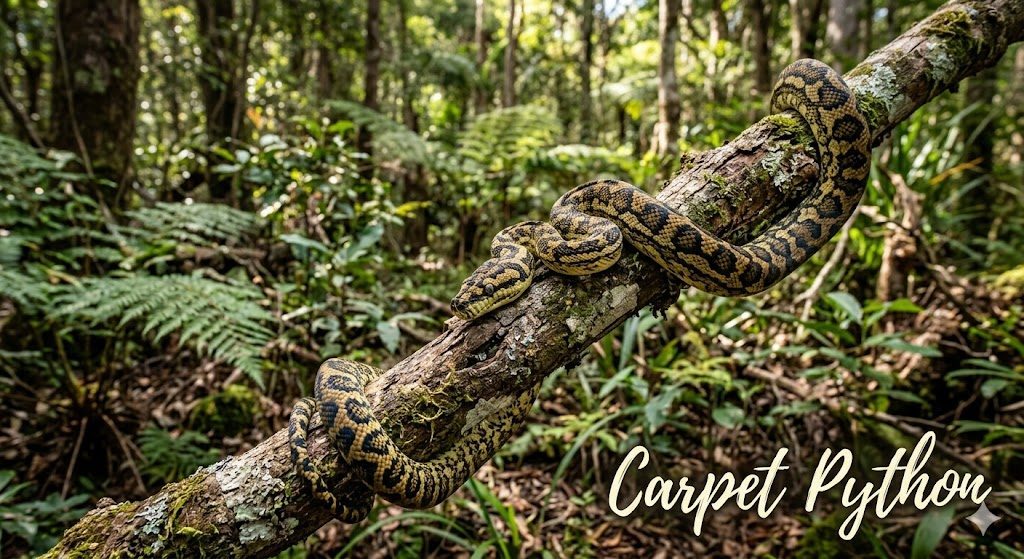
Image: Wikimedia Commons
Experience
Intermediate
Lifespan
Species-dependent
Adult Size
5–9 ft
Origin
Australia, New Guinea, the Bismarck Archipelago, a
Carpet Python
Image: Wikimedia Commons
Origin Australia, New Guinea, the Bismarck Archipelago, and the northern Solomon Islands Adult size 5–9 ft depending on subspecies — smaller locales (Jungle, Irian Jaya) average around 5–6 ft, while Coastal carpet pythons can reach 8–9 ft Lifespan 20+ years in captivity Experience level Intermediate — manageable husbandry, but size and a snappy juvenile phase call for some prior snake-keeping experience
Juveniles are often defensive and quick to strike; most adults settle into a calm, confident temperament with regular handling Venom Non-venomous; kills prey by constriction
Carpet pythons make up a complex of subspecies spread across Australia, New Guinea, the Bismarck Archipelago, and the northern Solomon Islands, and few pythons occupy as much ecological ground. Within this single species complex, populations have adapted to tropical rainforest, eucalypt woodland, coastal scrub, arid savanna, rocky outcrops, and even the rooftops and rafters of suburban Australian neighborhoods. This wide range is also why "carpet python" care can vary by subspecies — a Coastal carpet python from humid Queensland forest and an Irian Jaya animal from dry New Guinea savanna come from genuinely different climates, even though both are kept similarly in captivity. Across the complex, carpet pythons are semi-arboreal generalist predators, equally comfortable hunting from the ground or ambushing prey from low branches. Wild diet includes small mammals, birds, and reptiles, and this adaptability extends to a strong, durable build that makes the species well suited to a wide range of captive setups. The Diamond python, a southern subspecies found at higher altitudes and latitudes than any other python species worldwide, shows just how far this group's tolerance for cooler conditions can stretch. In captivity, this background translates into a snake that wants a real thermal gradient and the option to climb, rather than one narrow set of "correct" numbers. Most keepers find carpet pythons hardy and food-motivated once their basic needs — space, a workable gradient, secure footing and climbing structure — are met, with the main challenge for new keepers being managing a notably defensive juvenile phase before the snake settles into its calmer adult temperament.
Cypress mulch, coconut coir, and organic topsoil blends all work well and help maintain moderate humidity without becoming waterlogged. Whatever substrate is used, the enclosure should stay well ventilated — damp substrate paired with stagnant air is the most common path to respiratory and skin problems in this species.
Provide secure hides at both the warm and cool ends, along with sturdy, well-anchored branches at multiple heights to satisfy this species' strong climbing instinct. Dense foliage or cover items placed near climbing branches help a naturally semi-arboreal snake feel secure while using the vertical space in its enclosure.
Maintain a basking surface of 88–93°F on the warm end and let the cool end settle around 75–81°F, giving the snake a genuine gradient to move through rather than a single target temperature. Any heat source should run through a thermostat to prevent burns and temperature spikes, and a modest night-time drop is normal and not a cause for concern.
Carpet pythons generally do well with moderate ambient humidity in the 40–60% range, with access to a humid hide for additional support during shedding. Ventilation matters as much as the humidity number itself — a sealed enclosure that holds high moisture with little airflow creates ideal conditions for respiratory infections and skin issues, so balance humidity with consistent air exchange rather than chasing the highest number possible.
Hatchlings do well fed every 5–7 days, juveniles every 7–10 days, and adults every 10–14 days, adjusting frequency based on body condition rather than a fixed calendar. A snake carrying visible extra weight can go longer between meals, while a leaner animal may need more frequent feeding. Refusal & Fasting Notes Short fasts around shedding, cooler weather, or breeding season are normal and not usually a concern in an otherwise healthy snake. Persistent refusal paired with weight loss should prompt a check of enclosure temperatures and hide availability, and a consult with an experienced reptile veterinarian if it continues.
Offer a sturdy water dish large enough for the snake to soak in if it chooses, and refresh it regularly to keep it clean. Soaking can support both hydration and a clean shed, particularly in drier sections of the enclosure.
Juvenile carpet pythons are notorious for being quick to strike and can take months of consistent, gentle handling to settle down — this is normal for the species and not a sign of a poorly suited pet. Most adults become considerably calmer and tolerate regular handling well. Always support the body fully without gripping or restricting movement, since a restrained snake is more likely to become alarmed, and avoid handling for 48–72 hours after a meal to allow undisturbed digestion. Handling any python carries some risk and is done at the keeper's own discretion.
Signs A python preparing to shed takes on a duller look and its eyes cloud over to a milky blue as the new skin separates underneath. Appetite often drops during this stage, and the snake should not be handled while its eyes are clouded, since vision is impaired and it may be more defensive than usual. During the Process The eyes clear a few days after clouding, with the shed typically following soon after. Stuck shed and retained eye caps are most often linked to humidity that has run too low or a lack of rough surfaces such as branches or rock decor for the snake to catch the skin on while shedding. Post-Molt / Post-Shed Care Check that the shed came away whole, with particular attention to the tail tip and eye caps. If skin remains stuck, a brief increase in humidity along with access to rough décor usually resolves it; persistent retained shed, especially around the eyes, should be evaluated by a reptile veterinarian.
Respiratory infections are the most significant health concern in captive carpet pythons and are almost always tied to an
immediate review of airflow and moisture levels, along with a veterinary visit if symptoms persist. Retained shed, particularly around the eyes, usually points to insufficient humidity or a lack of rough surfaces during shedding. Quarantine new animals before introducing them to an existing collection to guard against mites and other parasites. Because juveniles can be defensive, stress-related refusal to eat is also common early on and typically resolves as the snake settles into a stable routine.
Carpet pythons are egg-laying (oviparous), and breeding in captivity is well established across several subspecies and their morphs. Many breeders use a seasonal cooling period to help trigger reproductive behavior, gradually lowering night-time temperatures over several weeks before returning the snake to normal conditions and introducing a proven pair. Females brood their eggs and will shiver to generate warmth if artificial incubation is not used. All breeding should be carried out using captive-bred stock only. Sources This guide was compiled using commonly accepted husbandry practices from experienced keepers and industry-standard reptile care resources.
Print-friendly version of this guide — formatted for keepers on the go.
Download PDF