🕷️ Tarantulas
Brazilian Red & White Tarantula Care Guide
Nhandu chromatus — Schmidt, 2004
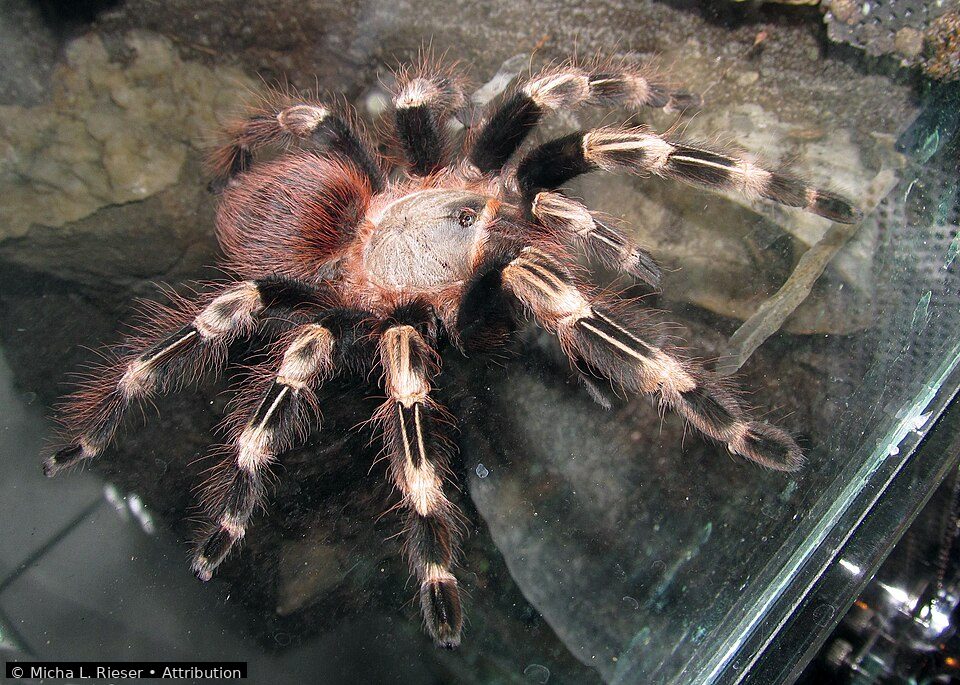
Image: Wikimedia Commons
Experience
Intermediate
Lifespan
Up to 15 years (females)
Adult Legspan
6–7 in DLS
Origin
Brazil & Paraguay
Nhandu chromatus — Schmidt, 2004
Image: Wikimedia Commons
Nhandu chromatus — the Brazilian Red & White — is a large terrestrial species from the forest edges and grasslands of southern Brazil and Paraguay. It is a ground-dweller with strong fossorial leanings, excavating burrows and webbing the substrate around its retreat.
Its habitat is warm with a moderate, seasonally variable humidity, which translates into easy captive care: mostly dry to lightly damp substrate, warm room temperatures, and good ventilation. The species is hardy and fast-growing, which has made it popular despite its attitude.
It is a genuinely striking spider — jet-black legs boldly banded in white, a carapace edged in pale gold, and a covering of red hairs on the abdomen. Bold, fast, and quick to defend itself, it is best thought of as an intermediate display species rather than a beginner's first spider.
The Brazilian Red & White is terrestrial with fossorial habits. Give it floor space and a good depth of substrate to dig and web, and keep the enclosure low to protect this heavy-bodied spider from falls.
| Life Stage | Enclosure | Notes |
|---|---|---|
| Spiderling (under 1") | Deli cup / small vented container | Lightly damp substrate, deep enough to burrow, small water source |
| Juvenile (1–3") | 16 oz – 1 gal enclosure | Deep substrate, cork hide, shallow water dish |
| Sub-adult / Adult (3"+) | 10–20 gal or equivalent | 4+ in of substrate, cork hide, water dish, good airflow |
Provide at least 4 inches of substrate — coconut fibre, peat, or topsoil — plus a cork bark hide and a permanent water dish. This species will burrow and web heavily, so give it room to landscape its own retreat.
Warm room temperatures and moderate humidity suit this species. No supplemental heating is needed in most homes.
| Parameter | Target | Notes |
|---|---|---|
| Temperature | 70–80°F (21–27°C) | Room temperature is fine; avoid sustained drops below 65°F |
| Ambient Humidity | 60–70% RH | Moderate — lightly moist substrate with a drier surface |
| Substrate | Lightly damp | Mist lightly about once a week; never soggy |
| Water | Permanent water dish | Keep filled at all times |
This is a voracious, confident feeder with a strong prey response — one of the more dramatic species to watch at feeding time. It rarely refuses food outside of pre-moult.
Prey: Gut-loaded crickets, Dubia roaches, and the occasional mealworm or superworm. Keep prey no larger than the spider's abdomen.
Frequency: Juveniles every 5–7 days, adults every 7–10 days. Fast growth means juveniles eat readily; aim for a plump but not over-stretched abdomen.
Remove uneaten prey within 24 hours, especially during pre-moult when the spider is vulnerable.
Growth is fast for a tarantula, with frequent juvenile moults slowing to roughly once a year in adults. Each moult sharpens the bold black-and-white banding and the red abdominal hairs.
Pre-moult signs: A darkened abdomen, food refusal, lethargy, and a web mat over the burrow entrance. Remove all live prey at the first signs.
Post-moult: Leave the spider undisturbed and wait 7–14 days before feeding so the new exoskeleton and fangs harden fully. Keep the water dish topped up throughout.
Handling is not recommended for the Brazilian Red & White. It is fast, confident, and readily defensive — quick to adopt a threat posture, bolt, or kick hairs when disturbed. There is little to gain and real risk in handling a spider with this temperament and speed.
Urticating hairs are present (Type III) and rank among the more irritating in the hobby; this species flicks them freely. They can cause significant skin and eye irritation. Interact with the enclosure rather than the spider, use long tools for maintenance, and always keep the enclosure low and contained during rehousing.
Print-friendly version of this guide — formatted for keepers on the go.
Download PDF