🦎 Lizards
Bearded Dragon Care Guide
Pogona vitticeps
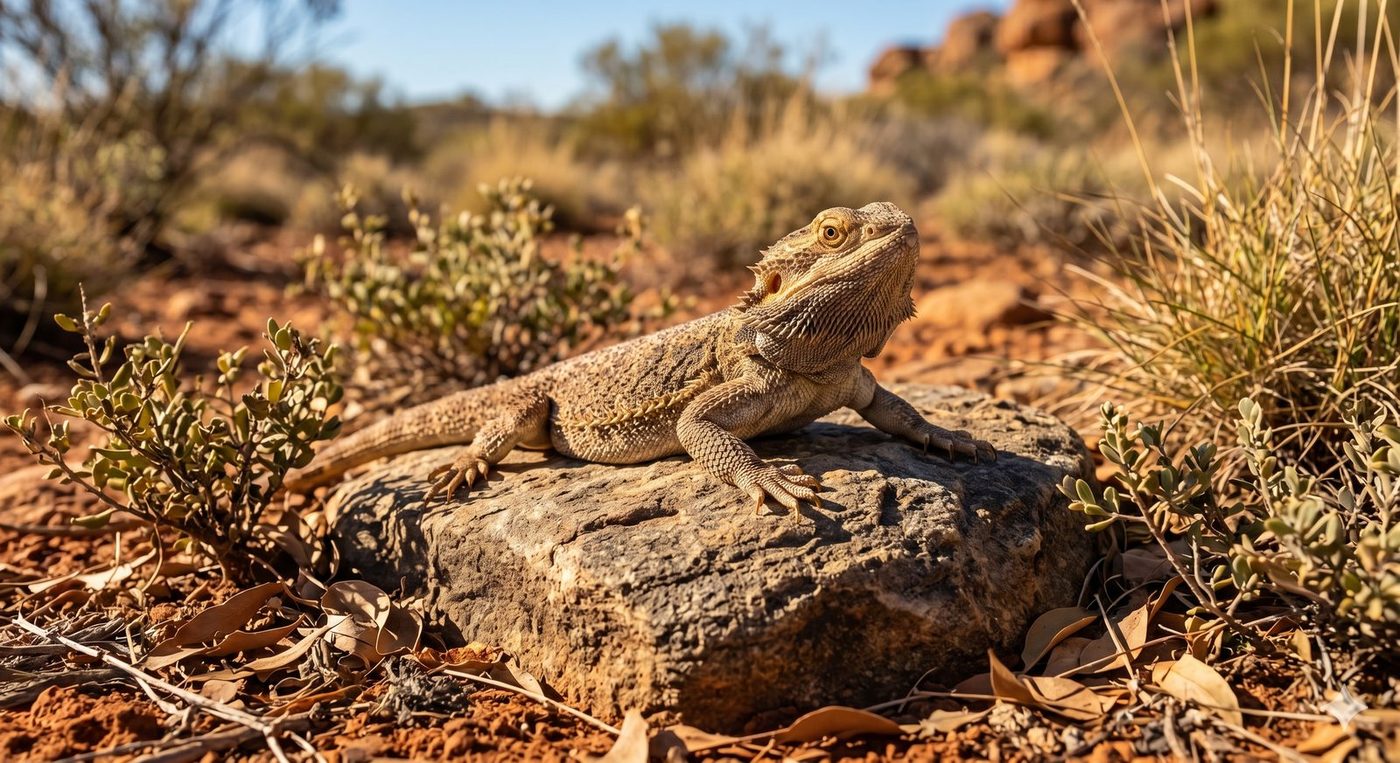
Image: Wikimedia Commons
Experience
Beginner
Lifespan
9–12 years
Adult Size
16–24 in
Origin
Adult size 16–24 in (40–60 cm) total length, inclu
Pogona vitticeps
Image: Wikimedia Commons
Venom None — completely non-venomous Activity Diurnal (day-active), needs a strong day/night light cycle
The central bearded dragon comes from the hot, dry interior of central and eastern Australia, where it ranges across open woodland, arid acacia scrub, mallee, and sandy desert. It is one of the most widespread lizards on the continent precisely because it tolerates harsh, variable conditions — blistering days, cool nights, and stretches where food is scarce. Beardies are semi-arboreal baskers. In the wild they perch on fallen timber, fence posts, and low branches to soak up sun and survey their territory, dropping to ground cover when threatened. That basking behavior is the single most important thing to understand about keeping them: they are heliothermic, meaning they regulate body
Bearded dragons need floor space and a long temperature gradient far more than height. For a single adult, provide a minimum of 4 ft long × 2 ft deep × 2 ft tall (120 × 60 × 60 cm) — and bigger is always better. That footprint is what lets you build a genuine hot end and cool end in the same enclosure. Hatchlings and small juveniles can be raised in a smaller enclosure or sectioned-down space so they can find food easily, but they grow fast and will need full adult housing within months. A front-opening glass terrarium or a Pvc enclosure both work well. Bearded dragons should be housed singly — they are territorial, and cohabitation routinely leads to stress, dominance, missing toes or tails, and outright fighting, even between pairs that "seem fine."
Provide at least one secure hide on the cool end so the dragon can fully thermoregulate and feel safe, plus elevated basking furniture (sturdy branches, rock, or a basking platform) on the warm end that lets the animal get close to the heat source. Backgrounds and climbing decor suit their semi-arboreal nature and reduce stress.
Build a clear gradient and verify every zone with a digital probe or temp gun — never rely on the dial on a thermostat alone. Zone Target Basking surface (warm end) 100–110°F (38–43°C) Warm side ambient 85–95°F (29–35°C) Cool side ambient 75–80°F (24–27°C) Night-time Allow a drop to roughly 65–75°F (18–24°C); no light needed Heat is best provided by a white halogen flood/basking lamp mounted overhead on the warm end, which delivers the bright, focused, infrared-rich heat dragons evolved to bask under. Position the basking perch so the animal's back sits at the correct surface temperature. At night, a dragon does not need heat unless your room drops well below the low 60s°F — and if supplemental heat is needed then, use a non-light-emitting source so the photoperiod isn't disrupted. These are arid-climate animals. Aim for a low ambient humidity, roughly 30–40% RH , with good ventilation. Chronically high humidity contributes to respiratory infections and scale problems. A simple water dish and the moisture from fresh greens are usually enough; routine misting is not required.
Uvb is not optional for this species — it is as essential as heat. Without it, dragons cannot synthesize vitamin D3, cannot use dietary calcium, and develop metabolic bone disease (Mbd) : soft bones, deformities, tremors, and eventually death. Use a high-output linear T5 HO Uvb tube (not a compact/coil bulb) running roughly half to two-thirds the length of the enclosure , mounted on the warm end so it overlaps the basking zone. Bulb strength is matched to the distance between the tube and the dragon's highest basking spot: Basking surface 10–12 in (25–30 cm) below the tube → a 6% (T5 HO) bulb Basking surface 12–18 in (30–45 cm) below → a 12% (T5 HO) bulb Basking surface up to 24 in (60 cm) below → a 14% (T5 HO) bulb If the tube sits above mesh, account for the Uvb the mesh blocks. Replace Uvb tubes on the manufacturer's schedule (typically every 12 months for T5 HO) — output fades long before the bulb stops producing visible light. Run a consistent 12–14 hours of light per day , with full darkness at night.
Bearded dragons are omnivores whose diet shifts from mostly insects as babies to mostly plants as adults. Prey & Plants Insects: Feeder staples include dubia roaches, crickets, black soldier fly larvae, and occasional treats like hornworms or silkworms. Avoid wild-caught insects (pesticide and parasite risk) and use mealworms/ superworms sparingly due to their hard chitin. As a sizing rule, no feeder should be larger than the space between the dragon's eyes, to avoid choking and impaction. Gut-loading matters: feed your feeder insects nutritious greens and veg for 24–48 hours before offering them — dusting powder is a supplement, not a substitute for well-fed prey. Greens & vegetables (the staple for adults): collard greens, mustard greens, turnip greens, dandelion greens, escarole, and squashes are excellent. Offer fruit only occasionally as a treat. Avoid spinach and other high-oxalate greens as a staple, since they bind calcium.• Age Insects Plants Hatchling (0–3 mo)Multiple insect feedings daily, as much as eaten in ~10– 15 minFresh greens available daily Juvenile (3–8 mo) Insects roughly 1–2× daily Greens daily, increasing share Sub-adult (8–14 mo)Insects about once daily Greens daily Adult (14+ mo) Insects every other day (smaller portion) Greens daily — now the bulk of the
Supplementation Proper dusting is the second pillar (with Uvb) of preventing Mbd. General schedule, adjusted to your specific Uvb setup: Juveniles (fast-growing): plain calcium (no D3) on most insect feedings; calcium with D3 a few times weekly; a reptile multivitamin about once weekly. Adults: plain calcium a couple of times weekly; calcium with D3 once or twice weekly; multivitamin about once weekly. Do not dust every feeding with a D3 product on top of strong Uvb — over-supplementing D3/vitamin A is a real risk. Match the schedule to your lighting and adjust for growth, breeding, or vet guidance. Refusal & Fasting Notes Appetite naturally dips with seasonal cooling and during brumation (a winter slow-down). A short refusal in a dragon with good body condition, correct temps, and current Uvb is usually not an emergency. Prolonged refusal paired with weight loss, lethargy, sunken eyes, or black-bearding stress signals warrants a check of husbandry and a reptile vet.
Provide a shallow, clean water dish; many dragons drink readily, others prefer water droplets or hydration from greens. Keep the dish clean and don't let it spike enclosure humidity. Some keepers offer occasional lukewarm soaks, especially to aid shedding or mild dehydration, but soaking is not a substitute for proper husbandry.
Bearded dragons are among the most handleable lizards and generally tolerate gentle, regular interaction well once acclimated. Support the whole body and limbs, keep early sessions short, and let a new dragon settle in for a• and give space when you see them. As with any animal, handling is done at the keeper's discretion and the dragon's comfort comes first.
Unlike snakes, dragons shed in patches rather than one piece, and do so frequently when young and growing. Signs include dulled or grayish skin and flaking. Support healthy sheds with correct husbandry and the option of a warm soak; do not peel stuck shed , especially around toes and the tail tip, where retained shed can constrict and cause damage. Persistent stuck shed on digits or tail should be addressed promptly.
The most common serious problem is metabolic bone disease , which is almost entirely preventable with correct Uvb, calcium, and basking temperatures. Other issues to watch for include impaction (often linked to loose
damp, or stagnant conditions), internal parasites (especially in newly acquired animals — a fecal check is wise), and adenovirus in some lines. A dragon that is lethargic, not basking, losing weight, straining, or persistently dark-bearded should be seen by a reptile-experienced veterinarian. Brumation Many bearded dragons naturally brumate — a winter dormancy triggered by shortening days and cooling temps — during which they slow down, hide, and eat little or nothing for weeks to a couple of months. In a healthy adult this is normal. Ensure the animal is parasite-free and in good condition beforehand, keep clean water available, and do not force-feed a brumating dragon. Hatchlings and underweight or sick animals should generally be kept warm, lit, and feeding rather than allowed to brumate; consult a vet if unsure.
has the husbandry fully dialed in. It typically follows a controlled brumation/cooling cycle to trigger reproductive readiness, with careful conditioning of the female to support egg production and a proper lay box for nesting. Females can become egg-bound without adequate calcium and a suitable laying site, so breeding raises the stakes on every other parameter in this guide. Work only with healthy, unrelated, captive-bred stock. This guide was compiled using commonly accepted husbandry practices from experienced keepers and industry- standard reptile care resources.
Print-friendly version of this guide — formatted for keepers on the go.
Download PDF