🕷️ Tarantulas
Antilles Pinktoe Tarantula Care Guide
Caribena versicolor — Walckenaer, 1837
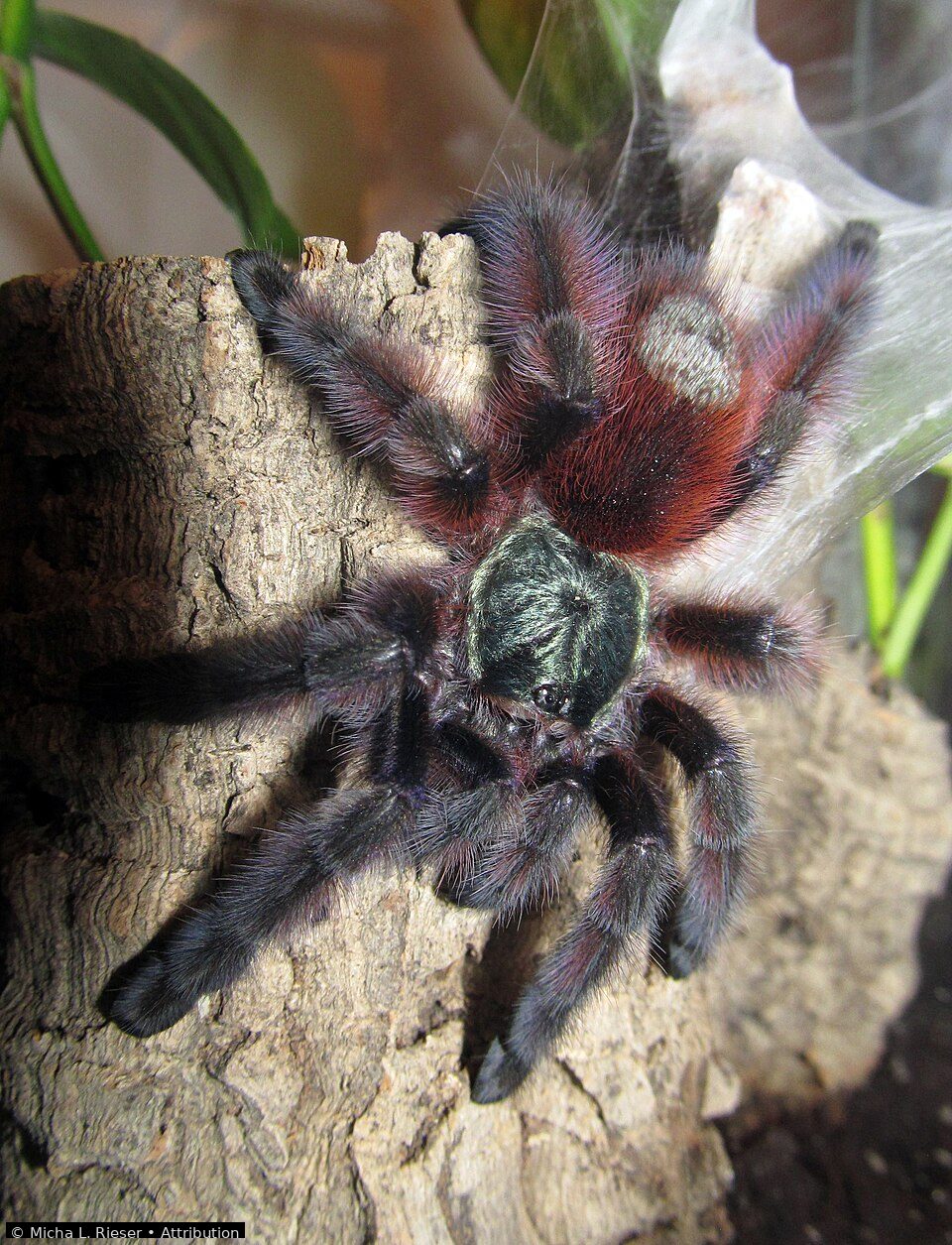
Image: Wikimedia Commons
Experience
Intermediate
Lifespan
Up to 12 years (females)
Adult Legspan
5–6 in DLS
Origin
Lesser Antilles
Caribena versicolor — Walckenaer, 1837
Image: Wikimedia Commons
Caribena versicolor — the Antilles or Martinique Pinktoe — is an arboreal species native to the islands of the Lesser Antilles, chiefly Martinique and Guadeloupe. It lives high in trees and tall vegetation, anchoring silken tube-webs in the canopy where warm, humid air is kept fresh by constant breeze.
That airy, high-canopy origin is the single most important fact in its care: it needs high humidity combined with strong ventilation. Stagnant, damp air is deadly to this species, which makes it a touch more demanding than a beginner terrestrial — but the reward is one of the most beautiful tarantulas in the world.
Spiderlings emerge an electric blue, then shift through successive moults to the adult's green carapace, red-and-purple abdomen, and pink-tipped feet. Calm by nature but fast and prone to leaping, the Antilles Pinktoe is the classic introduction to arboreal keeping for those ready to manage its ventilation needs.
This is an arboreal species, so height matters more than floor space. Use a tall enclosure with cross-ventilation (vents on opposite sides or front and top) and tall anchor points for webbing. A front- or side-opening enclosure is ideal, as reaching down from above startles the spider and tears its web.
| Life Stage | Enclosure | Notes |
|---|---|---|
| Spiderling (under 1") | Tall vented vial / small arboreal cup | Vertical cork, anchor points, light moisture, heavy ventilation |
| Juvenile (1–3") | Tall acrylic or 2–4 gal vertical | Cork tube, fake foliage, cross-ventilation |
| Sub-adult / Adult (3"+) | 12×12×18 in (or taller) vertical | Vertical cork bark, plants, water dish, strong cross-ventilation |
Provide a vertical cork bark slab or tube against one wall, plus fake plants, so the spider can build its tube-web off the ground. A shallow layer of substrate (2–3 in) holds light moisture and cushions any fall, but this species lives up top, not in the dirt.
Warm, humid, and well-ventilated mirrors the island canopy. Achieving humidity without stagnant air is the whole game with this species.
| Parameter | Target | Notes |
|---|---|---|
| Temperature | 75–82°F (24–28°C) | Stable warmth; avoid sustained drops below 70°F |
| Ambient Humidity | 70–80% RH | High — but always paired with strong cross-ventilation |
| Moisture | Light misting | Mist part of the web/wall every 1–2 days; let it dry between |
| Water | Small water dish | Provide a dish; the spider also drinks droplets off misting |
Pinktoes are active, visual hunters that ambush prey from their web. They are enthusiastic feeders and often snatch prey mid-air.
Prey: Gut-loaded crickets and flying insects, plus small Dubia roaches. Keep prey no larger than the spider's abdomen. Flying prey suits this aerial hunter well.
Frequency: Spiderlings twice a week, juveniles every 5–7 days, adults every 7–10 days. Arboreals are more prone to dehydration than terrestrials, so keep moisture and water consistent.
Remove uneaten prey within 24 hours so it cannot disturb the spider in its web retreat.
Pinktoes typically moult inside their tube-web, often on their backs or sides. Each moult deepens the green-and-red adult colouration. Growth is moderate, slowing to once or twice a year in adults.
Pre-moult signs: A darkened abdomen, food refusal, and increased time sealed in the web. Remove all live prey at the first signs.
Post-moult: Leave the spider completely undisturbed and wait 7–14 days before feeding so the new exoskeleton and fangs harden. Keep humidity steady throughout — fresh moults are vulnerable to drying out.
The Antilles Pinktoe is docile and rarely defensive, but it is extremely fast and known for sudden leaps. A startled pinktoe can launch off a hand without warning, and a fall from height is dangerous for an arboreal spider. For these reasons handling is generally discouraged, and is always at the keeper's own risk.
This species has weak urticating hairs (Type II) and may also flick faecal matter as a defensive bluff rather than stand its ground. Keep any unavoidable contact — such as rehousing — low, calm, and over a soft surface, and work with the enclosure rather than the spider whenever possible.
Print-friendly version of this guide — formatted for keepers on the go.
Download PDF